Yellowstone's Story Continues
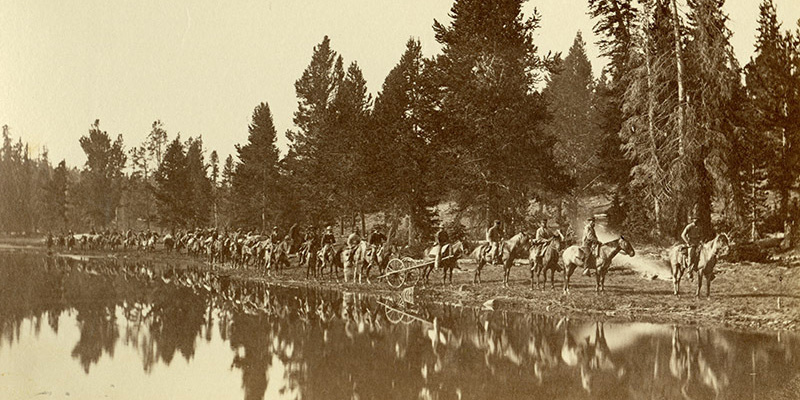 Hayden Expedition, Yellowstone, 1871, photo courtesy NPS, William Henry Jackson
National Park Week begins tomorrow with this year’s theme, “Celebrating America’s Story.” And what a story our beloved Yellowstone National Park holds. For more than 11,000 years, 27 different Native American tribes visited geysers, conducted ceremonies, hunted, gathered plants and minerals and engaged in trade.
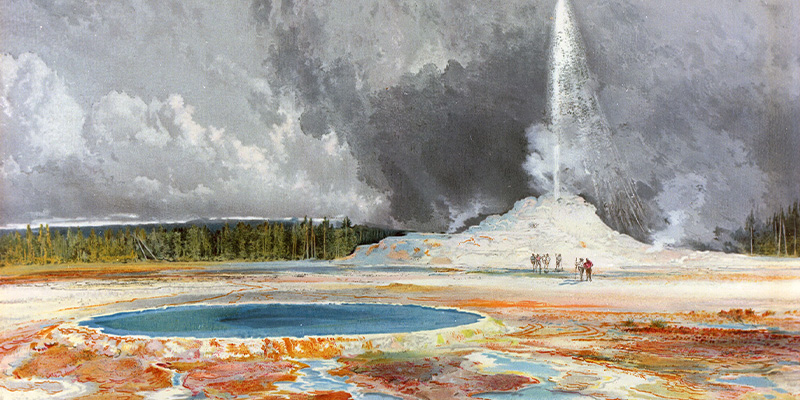 Photo courtesy NPS, painting by Thomas Moran, The Castle Geyser, Upper Geyser Basin, Yellowstone National Park
Becoming the World’s First National Park
Centuries later, the U.S. government began formal expeditions to explore and map the area. One of these expeditions was the 1871 Hayden Expedition, which marked the beginning of the history of science in Yellowstone. Hayden’s team included two botanists, a meteorologist, a zoologist, an ornithologist, a mineralogist, a topographer and an agricultural statistician/entomologist. It also included an artist, Thomas Moran, and a photographer, William Henry Jackson. The expedition gave the world an improved map of Yellowstone and visual proof of how special this area was through Jackson's photography, Moran's paintings and sketches from another artist, Henry W. Elliot. Their work excited the scientific community, as well as Congress. On March 1, 1872, President Ulysses S. Grant signed the Yellowstone National Park Protection Act, making it the world’s first National Park.
The railroad arrived in 1883, allowing easier access for visitors. With increased visitation came more people and more troubles with “squatters” and people poaching the wildlife. As such, the U.S. Army was sent to manage the park from 1886 to 1918.
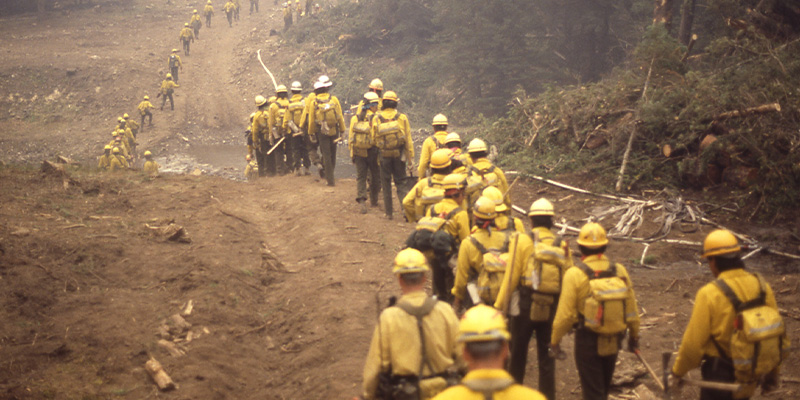 Photo courtesy NPS, military firefighters, Yellowstone Fires, 1988
The Summer of Fire
Of course, it’s hard to forget the fires of 1988, and what turned out to be an instrumental event in the public’s understanding of forest fires and our ecosystem. After a wet June, park managers and fire behavior specialists allowed 18 lightning-caused fires to burn, expecting rain in July as well. Many fires burned themselves out, as they usually did, but the weather became extremely dry, and within a week, the fire acreage doubled to about 17,000 acres. An extensive interagency fire suppression effort began mid-July, but extreme weather conditions and heavy accumulations of dry fuel created fire conditions rarely observed. It was determined that only rain or snow could stop the blazes, and on Sept. 11, a quarter-inch of snow finally stopped the fires. In total, 36% of the park burned, with 793,880 acres affected. 42 fires were caused by lightning, and 9 by humans.
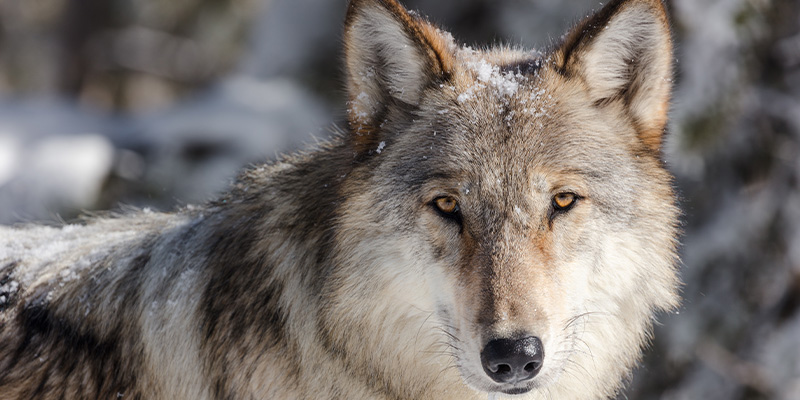 Photo courtesy NPS, Jacob W. Frank
Reintroduction of Wolves
Early park managers didn’t understand how wolves fit into the ecosystem, and in the late 1800s and early 1900s, they viewed them as predators and routinely killed them. In 1926, the last wolf pack was killed, although single wolves were occasionally spotted. In 1991, Congress allocated funding for an Environmental Impact Study on the wolves, which garnered 160,000 public comments, the largest at the time of any federal proposal. In 1995-1996, 31 gray wolves from Western Canada were reintroduced to the park. Originally, they called for a 5-year reintroduction plan, but the program had such early success that no additional transplants were needed.
As a result of the reintroduction, Yellowstone has seen a positive trickle-down effect across the ecosystem. One of those effects is that the predatory pressure keeps elk moving around. Without that pressure, they remained in one area and heavily browsed on willow, aspen and cottonwood, which was difficult for the beavers who rely on willow. At the time of reintroduction, there was one beaver colony; today there are nine. The beavers have spread and built new dams and ponds, which has a cascade effect, including storing water that then recharges the water table, providing cold, shaded water for fish, and the robust willow stands providing habitat for songbirds.
Together, these changes have given scientists a real-time view of the effects of restoring an ecosystem.
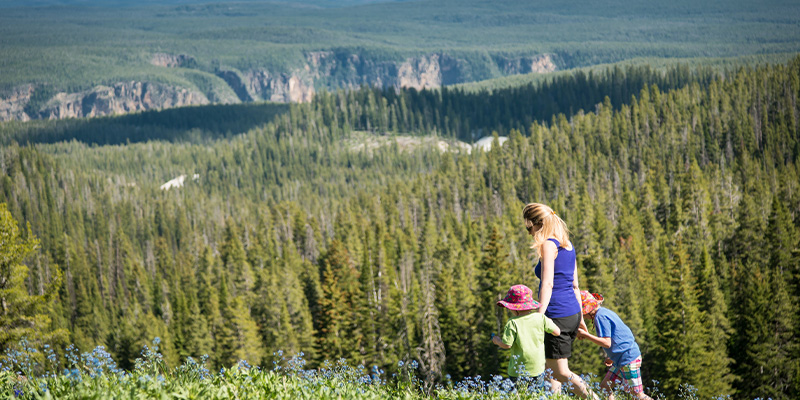 Yellowstone National Park, photo by Audrey Hall
Yellowstone’s Priorities Today
Today, Yellowstone’s strategic priorities include supporting its teams, improving strategic management and organizational effectiveness, strengthening the ecosystem and heritage resources, delivering a world-class experience, investing in infrastructure, and building partnerships with tribes, gateway communities and elected officials.
Yellowstone is a national treasure, and we’re honored to be stewards of this special place.
This Tuesday, August 25th, National Park fees are waived for the 110th birthday of the National Park Service.